
Gutter Repair vs Replacement: Which Do You Need?
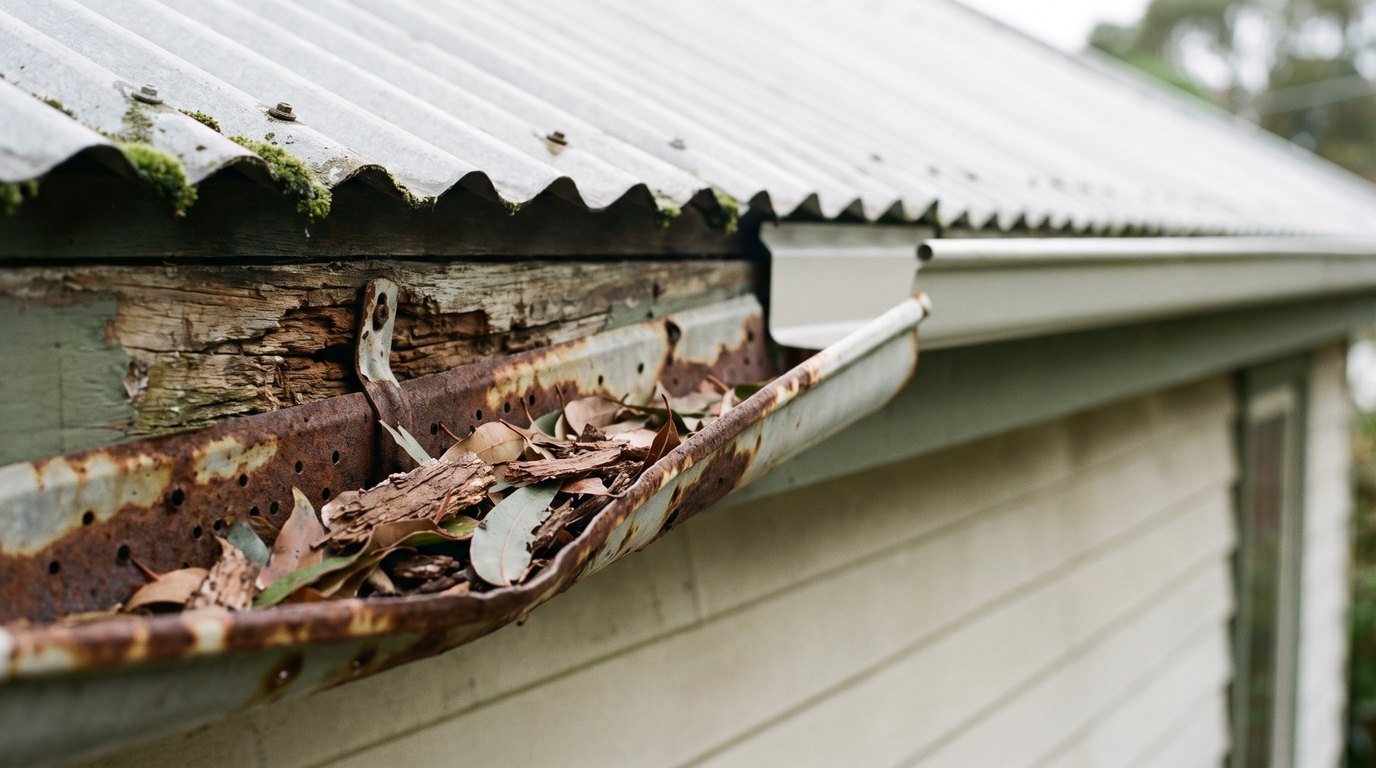
You notice a drip behind the downpipe, or a rust stain running down the weatherboards, and the question arrives: is this something that can be patched, or is it time for new gutters?
It is a fair question and an expensive one to get wrong. Patch a system that is already at the end of its life and you pay twice. Replace a system that had years left in it and you have spent thousands you did not need to.
Here is how the decision actually gets made on a Hobart home, what the market ranges look like, and the local details that most online advice skips.
What repair and replacement actually mean
A gutter repair fixes a defined fault while leaving the rest of the system in place. That covers resealing a leaking joint, treating and sealing a patch of surface rust, refitting or replacing failed brackets, straightening a sagging run, or swapping out one or two damaged lengths after a storm.
A replacement takes the whole run off, or the whole system, and starts again. It usually includes new brackets and fixings, often new downpipes, and sometimes fascia work where the timber behind has gone soft.
The two are not really competing options. They are answers to two different situations, and the job of an inspection is to work out which situation you are in.
The five signs, and what each one is telling you
Most gutter problems announce themselves in one of five ways. What matters is not the symptom itself but how widespread it is.
Rust and corrosion. A patch of surface rust on one length is a repair. Rust that has gone through to perforation, especially in three or more separate spots, is a system telling you it has reached the end. Rust rarely appears in isolation, because whatever caused it, usually sitting debris and trapped moisture, has been working on the whole run equally.
Sagging or pulling away from the fascia. If the gutter itself is sound and the brackets have simply let go, re-bracketing is a straightforward repair. If the timber fascia behind it has rotted, the fix gets bigger, because there is nothing solid left to fix the new brackets to.
Leaking joints and seams. Sealant does not last forever. A joint that has started weeping on an otherwise healthy gutter is a routine reseal. Multiple joints failing at once on an older system usually means the whole thing is the same age and heading the same way.
Constant overflow. If your gutters overflow every time it rains properly, and they still overflow after a clean, the problem is not debris. Either the fall is wrong, the downpipes cannot cope, or the profile is undersized for the roof area feeding it. That is a design problem, and no amount of patching fixes a design problem. We have written separately about the causes behind blocked and overflowing gutters if you want to rule out the simple explanations first.
Water marks on the fascia, eaves or walls. Staining below the gutter line means water has been escaping for a while. It is worth taking seriously, because the cost of the gutter is small next to the cost of repairing what sits behind it.
When repair is the right call
Repair makes sense when the fault is contained and the rest of the system has life left in it. In practice that means the damage sits in one or two spots, the gutter body is otherwise sound with no perforation elsewhere, the fascia behind is solid, and the same fault has not already been fixed once before.
The last one matters more than people expect. A repair that fails within twelve months is not bad luck, it is a signal that the underlying condition is worse than it looked.
Repair is also the sensible first move when you are not sure. A competent inspection and a targeted fix costs far less than a replacement, and it buys you accurate information about the state of the rest of the system.
When replacement is the better call
Replacement becomes the better value option when the failures are recurring, spread across multiple sections, or structural.
The clearest triggers are perforation in several separate runs, a system where you are patching a new leak every season, fascia damage extensive enough that re-bracketing is not viable, and gutters that are simply too small for the roof they serve.
Age alone is not a reason to replace. Condition is. But age changes the odds, and it changes how much you should be willing to spend on a patch. Spending several hundred dollars keeping a clearly end-of-life system going is money that would be better put toward the replacement you will be doing anyway.
What it costs
There is no single price, and anyone who gives you one over the phone is guessing.
For national context, Canstar reported in 2025 that gutter replacement in Australia is usually priced either hourly or by lineal metre, with professionals charging around $60 to $70 per hour, and per metre rates running from about $30 up to $160 depending on the material. Their material breakdown, sourced from hipages, put PVC at roughly $30 to $35 per lineal metre installed, Zincalume at $30 to $50, colour-coated Zincalume at $45 to $67, and stainless steel at $85 to $160.
Two honest caveats. First, those figures are from 2025 and material prices move, so treat them as a starting point rather than a quote. Second, when Canstar compiled average hourly rates by city, no prices were supplied for Hobart at all. That is a decent illustration of the problem with national pricing guides: our market is small, our housing stock is old, and our access is often harder than the mainland average.
The more useful question is not what a metre costs but what the whole job includes. Two quotes for the same house can differ by thousands because one of them accounts for scaffolding on a sloping site and the other does not.
What Tasmanian conditions do to the decision
Most repair versus replacement advice online is written for Sydney or Brisbane, and it leans heavily on coastal salt corrosion and subtropical storm damage. Neither is the main driver here.
In Greater Hobart the pressure comes from organic load and moisture. Gum trees drop leaves, bark and twigs all year rather than in one tidy autumn window, and deciduous street trees add to it. That debris sits wet in the gutter through our cool, damp months, and constantly wet steel corrodes from the inside out. It is very common to find a gutter that looks respectable from the ground and is badly pitted along the base.
Shaded southern-facing roofs in the foothills hold moisture longer again, which is why moss and lichen on the roof edge is worth noticing. Older weatherboard homes often have original timber fascia, and once that has taken years of overflow it can be the thing that decides the job, not the gutter.
Bushfire is the other local factor. Tasmania Fire Service advice on preparing a property is to keep roofs and gutters clear of flammable debris and to seal openings so embers cannot get in. If you are replacing gutters on a bush-adjacent block, that is the natural moment to look at ember-rated metal mesh at the same time, because the access and the labour are already paid for.
What a warranty actually promises
Competitors will tell you Colorbond gutters last twenty to thirty years. That number generally comes from experience rather than a document, so it is worth knowing what the manufacturer actually commits to.
BlueScope's sample warranty for COLORBOND steel used as eave gutters, fascia and downpipes offers cover of up to twenty years from installation against corrosion to perforation by weathering, and up to twenty years against the paint system flaking or peeling when used as eave gutters and downpipes. The actual period varies with the environment and the specific product, which is exactly why it is written that way.
Read that carefully and it tells you two useful things. Twenty years is the outer edge of what the maker will stand behind, not a floor. And warranties cover weathering, not neglect, so a gutter that has spent a decade full of wet leaves is not a warranty conversation. Our guide to looking after Colorbond gutters goes into what actually extends that life.
Sizing and overflow: the part nobody mentions
If your gutters overflow in heavy rain despite being clean, the system may simply not meet current expectations for capacity.
Roof drainage in Australia is covered by AS/NZS 3500.3, which the National Construction Code references as a deemed-to-satisfy pathway. A revised edition was published in April 2025, and it overhauled the rules for eaves gutter overflow and valley gutter sizing, with overflow provisions designed on the basis that the downpipes are fully blocked.
You do not need to know the detail. What you need to know is that a replacement is the only realistic opportunity to correct undersized guttering or add proper overflow provision, and that a quote which simply matches what is already there may be replicating the original problem in new steel. It is a reasonable thing to raise with your installer.
Who is allowed to do the work in Tasmania
This one catches people out. Roof drainage is licensed plumbing work in Tasmania.
Consumer, Building and Occupational Services requires a plumbing practitioner licence covering the roof stormwater stream for this kind of work. Builders can only carry out certain roof drainage work if they hold a specific roof drainage endorsement on their licence, and CBOS is explicit that builders without it must not perform roof drainage work at all.
So when you are comparing quotes for a replacement, asking who will actually be doing the work and under what licence is not being difficult. It is the single easiest way to filter a list of quotes.
If it is a rental or investment property
There is a tax dimension here that is worth understanding before you choose, and it can push the numbers in an unexpected direction.
The Australian Taxation Office treats replacing part of a gutter as a repair, which a landlord can generally claim immediately. Replacing the entire gutter is capital in nature and is claimed over a number of years instead of in the year you pay for it.
That does not mean you should patch a failed system for tax reasons. It does mean the after-tax cost of the two options can be quite different, and it is worth a conversation with your accountant before signing off on a full replacement. We are gutter cleaners rather than tax advisers, so treat this as a prompt to ask the question, not as advice.
Why the inspection matters more than the quote
Everything above depends on knowing the real condition of the gutter, and you cannot establish that from the ground.
That is also the part you should not be doing yourself. WorkSafe Tasmania is clear that falls are a major cause of serious injury and death in Tasmanian workplaces, and that portable ladders are among the least stable ways of working at height. A wet Hobart roof in July, on a sloping block, is not the place to satisfy your curiosity.
A proper inspection means someone getting eyes and hands on the full length of the gutter, checking the base for pitting rather than just the face, testing bracket fixings, and looking at the fascia behind. That is what turns a guess into a decision.
What a good quote should include
Whichever way the decision goes, a quote worth comparing should spell out:
- The specific faults found and where they are, not just a total
- Whether the work is a repair, a partial replacement or a full replacement, and why
- Material and profile, and whether new gutters match or improve on the existing capacity
- New brackets, fixings and downpipes where relevant, and any fascia work
- Access requirements, including scaffolding on steep or multi-storey sites
- The licence held by whoever is doing the roof drainage work
- Product warranty and workmanship warranty, stated separately
A quote that is dramatically cheaper than the others usually has an answer hiding in one of those lines.
Get a straight answer about your gutters
If you are weighing up a patch against a replacement, the useful next step is not another price range online. It is someone looking properly at what you have got.
We clean, inspect and carry out minor gutter repairs across Greater Hobart, and where a job genuinely needs a licensed roof plumber we will say so rather than sell you something we should not. Get in touch with JK Gutter Cleaning Hobart for a no-obligation look over your gutters and an honest recommendation.
Frequently asked questions
Is it better to repair or replace gutters?
It depends on how widespread the damage is. Isolated faults on an otherwise sound system are worth repairing. Perforation in several separate sections, repeat failures within a year, or rotted fascia usually point to replacement being better value over time.
Can you replace just one section of gutter?
Yes. Partial replacement is common after storm damage or where rust has gone through in one spot, and it is often the right answer if the rest of the run is sound. Colour matching to older, faded guttering is the usual practical limitation.
How much does gutter replacement cost in Australia?
Canstar reported in 2025 that rates run from about $30 per lineal metre for PVC up to $160 for stainless steel installed, with labour around $60 to $70 per hour. Those are national figures from 2025, no Hobart hourly rate was published, and your cost depends on length, material, roof profile and access.
How long do Colorbond gutters last?
BlueScope's sample warranty for COLORBOND steel eave gutters offers up to twenty years against corrosion to perforation by weathering, with the exact period varying by environment and product. Real-world life depends heavily on how often debris is cleared out.
Do I need a licensed plumber to replace guttering in Tasmania?
Roof drainage is licensed plumbing work in Tasmania. It requires a plumbing practitioner licence covering roof stormwater, or a builder holding a specific roof drainage endorsement. Always ask which applies to the person quoting.
Need your gutters sorted in Hobart?
Book a fast, obligation-free quote with your local team.