
Downpipe Cleaning & Unblocking Explained
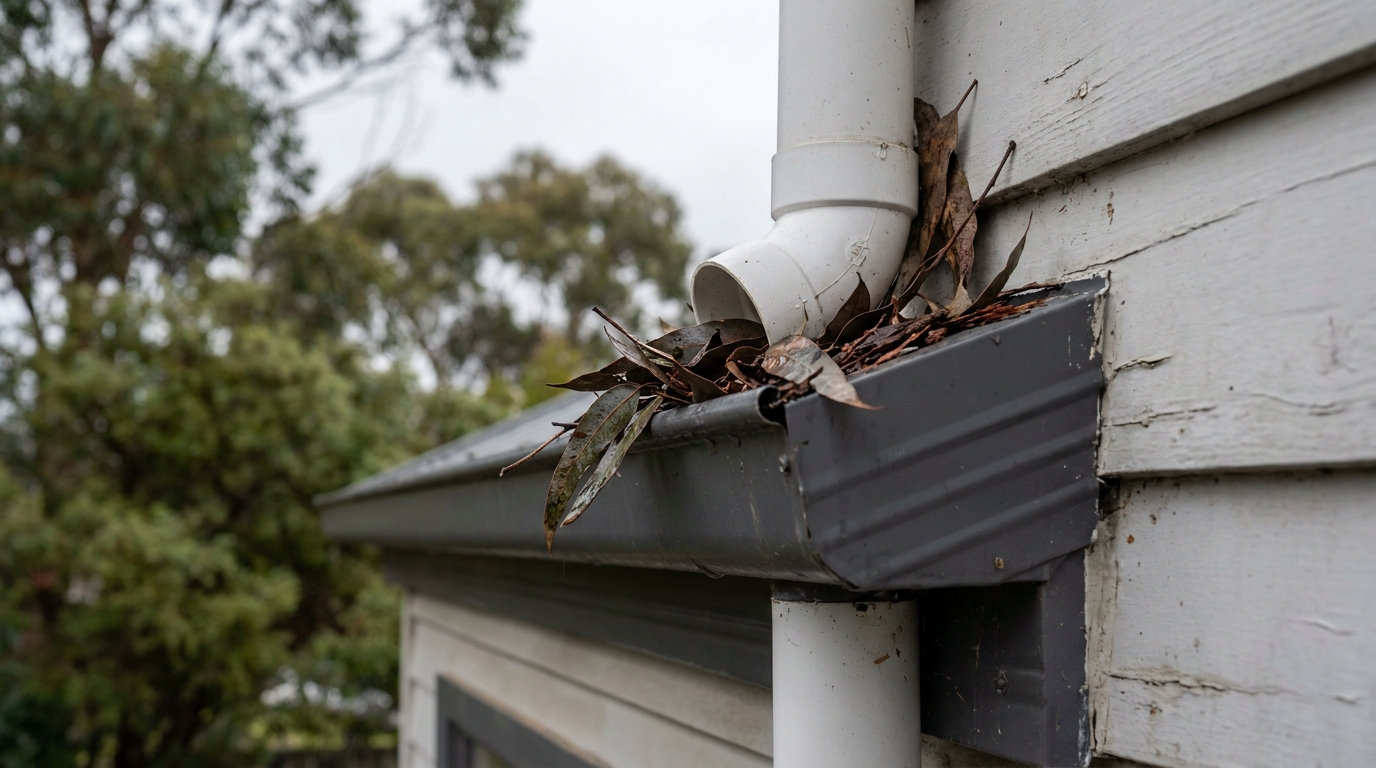
You cleaned the gutters a few months back, so when water starts sheeting over the edge in the first decent downpour, it doesn't add up. Look closer and you'll often find the gutter isn't the problem at all — the downpipe underneath it is.
Downpipes are the part of the system nobody thinks about until they stop working. They're narrow, they're hidden, and they collect exactly the sort of fine debris that Hobart's gum trees drop all year round.
Here's how to tell when a downpipe is blocked, how to clear it, and — importantly — how to work out whether it's a job you can do from a ladder or one that needs someone else entirely.
What a downpipe does, and why blockages start there
Your gutters only catch the water. The downpipe is what carries it down the wall and into the stormwater system, away from your foundations.
That makes it the narrowest point in the whole run. Everything the gutter collects gets washed along toward one small outlet, and whatever fits through drops into a pipe barely wider than a fist.
Most downpipes also have at least one bend — often a "swan neck" at the top that steps the pipe back under the eave. Debris that travels happily down a straight run will stop dead at that bend and start packing in behind itself.
Signs your downpipe is blocked
The clearest sign is water spilling over at one spot rather than along the whole gutter run. If the overflow is concentrated near a downpipe, the pipe below is the first suspect.
Other things to watch for:
- Gurgling or a hollow trickle coming from the pipe during rain, instead of a steady flow
- Water seeping from the joins between pipe sections or at the swan neck
- Nothing coming out the bottom while it's clearly pouring in at the top
- A damp patch or puddle at the base of the pipe, or moss and staining down the wall behind it
- Plants sprouting from the gutter right at the outlet — a sign debris has been sitting wet for a long time
A blocked downpipe rarely stays a downpipe problem. Water that can't drain sits in the gutter, spills against the fascia and walls, and ends up in the ground right beside your footings. Our guide to blocked and overflowing gutters covers what that water does over a wet Tasmanian winter.
What blocks downpipes in Hobart
Leaf litter is the obvious culprit, but the local mix matters. Gum leaves are narrow and stiff, so they slip through gutter debris and into the outlet where broader leaves would bridge across it.
Add shed bark, seed pods, roof grit and the fine eucalypt needles that wash down with every shower, and you get a dense, waterlogged plug rather than a loose clump. It compacts at the bend and sets like felt.
The other regulars are bird nests built in the top of the pipe over spring, and the occasional tennis ball or toy. Where a downpipe feeds an older hopper head, moss and silt build up in the hopper itself and choke the entry.
Work out where the blockage is before you touch it
This is the step most guides skip, and it's the one that saves you the most time. A blockage in the downpipe and a blockage in the underground stormwater line look identical from the ground — but they're completely different jobs.
The tap test. Knock along the pipe with your knuckles from top to bottom. An empty pipe sounds hollow; where it turns dull and solid, that's your blockage. Mark the spot.
The hose test. Run a hose into the bottom of the downpipe, at the point where it enters the ground. If the water backs up and pools straight away, the problem is below ground, not in the pipe on your wall.
If the pipe sounds hollow all the way down and water still won't drain away at the bottom, the blockage is in the stormwater line — and that's a licensed plumber's job, not a gutter cleaner's. Drain rods, jetting and camera work below ground are a different trade with different equipment. Knowing which one to ring first is worth the ten minutes it takes to check.
How to clear a blocked downpipe yourself
If the tap test puts the blockage in the pipe on the wall, it's often within reach of a careful DIY attempt.
What you'll need: a stable ladder, gloves, eye protection, a garden hose, and a length of stiff wire — a straightened coat hanger works — or a plumber's snake for anything deeper.
Clear the gutter first. There's no point flushing a downpipe while the gutter above it is still full; you'll only wash the same debris back into the outlet. Scoop the gutter out either side of the downpipe before you start.
Flush from the top. Feed the hose into the outlet and turn it on full. Light debris will often shift on its own, and you'll hear the pipe change note when it clears.
Work the blockage loose. If flushing doesn't do it, thread the wire down to the blockage and move it up and down to break the plug apart, then flush again. Go gently — jamming it hard tends to compact the debris rather than shift it.
Before you start, put a board or a rag over the drain at the base of the pipe. Debris you dislodge will drop straight down and can turn a downpipe blockage into a stormwater one.
Dismantle as a last resort. Downpipes are held on with clips screwed to the wall. If you can't reach the blockage, the section can be taken off, cleared and refitted — but you're now working at height with both hands busy, which is where most gutter-cleaning injuries happen.
Skip the baking soda and the drain chemicals
You'll find advice online recommending baking soda and vinegar, or a chemical drain cleaner, for a blocked downpipe. That advice has wandered across from blocked sinks, and it doesn't hold up here.
A downpipe blockage is packed wet leaves and bark. It's a physical plug, not a grease or soap deposit — there's nothing there for a chemical to dissolve, and any liquid you pour in simply sits on top of it.
Chemical drain cleaners bring real downsides too. They can damage some pipe materials, they're hazardous to handle overhead on a ladder, and whatever doesn't dissolve the blockage ends up in the stormwater system. Mechanical clearing is the method that actually works.
Staying safe up there
Nearly all downpipe work happens at height, often on wet ground. It's worth being honest about the risk.
Set the ladder on firm, level ground, have someone foot it, and keep your hips between the rails rather than stretching sideways for that last bit of reach. Wear gloves and eye protection — debris drops out of pipes without warning.
Never do it in wet or windy weather, and don't do it at all on a two-storey home or a steep roof. That's the point where the sensible move is to hand it over.
When to call a professional
Ring someone if the blockage is out of ladder reach, if the pipe is buried or runs down a two-storey wall, if it's still blocked after flushing, or if the hose test pointed underground.
Also worth a call if you're seeing damp inside the walls or staining on the ceiling near an external wall. That's water finding its way in rather than down, and the downpipe is only the symptom.
How professional downpipe cleaning works
If the blockage is out of reach, or you'd simply rather not be up a ladder in a Hobart winter, here's what the job looks like when we do it.
We use a gutter vacuum system that lifts debris out of the gutter and the top of the downpipe in one pass, including the wet, heavy material a hose just pushes further in. Because the debris comes out rather than getting flushed through, it doesn't end up wedged at the next bend or in your stormwater line.
From there it's a flush to confirm flow, a check that water is actually coming out at the bottom, and a look at the joins and brackets while we're on the ladder. If something needs a minor repair, you'll hear about it before we do anything.
If you'd rather leave it to someone else, get in touch for a free quote. We can usually give you a good idea over the phone.
Preventing downpipe blockages
Clean gutters are the whole game. Debris can't block a downpipe if it never reaches the outlet, so the twice-yearly clean most Hobart homes need — after the autumn drop and before winter — does most of the work.
If your place sits under gums and you're cleaning more often than that, gutter guard is worth considering. A quality mesh screens debris at the gutter mouth so it never washes down to the outlet, and it stops birds nesting in the pipe. Our comparison of gutter guard types walks through which mesh suits which situation.
The simplest habit costs nothing: next time it rains properly, walk around the house and check each downpipe. Water should be running out the bottom of every one. It takes two minutes and it's the earliest warning you'll get.
Frequently asked questions
How do I know if it's the gutter or the downpipe? Watch where the water goes over. Overflow along the whole run points to the gutter; overflow concentrated at one spot near a downpipe points to the pipe.
Can I use a pressure washer on a downpipe? It can work, but be careful. High pressure in a confined pipe can force joins apart and drive the blockage further down into the stormwater line, where it's much harder to reach.
How often should downpipes be cleaned? Usually twice a year for most Hobart homes, and more often under heavy tree cover — the same rhythm the gutters need.
Does gutter guard stop downpipe blockages completely? It dramatically reduces them by keeping debris out of the gutter, but guards still need occasional checking. Fine grit and pollen can pass through any mesh over time.
Should I call a plumber or a gutter cleaner? Above ground — the pipe on your wall — is gutter cleaning. Below ground, in the stormwater line, is a licensed plumber. The hose test at the base of the pipe tells you which one you need.
Need your gutters sorted in Hobart?
Book a fast, obligation-free quote with your local team.