
Leaking Gutter Repair: Causes, Fixes and When to Call a Pro
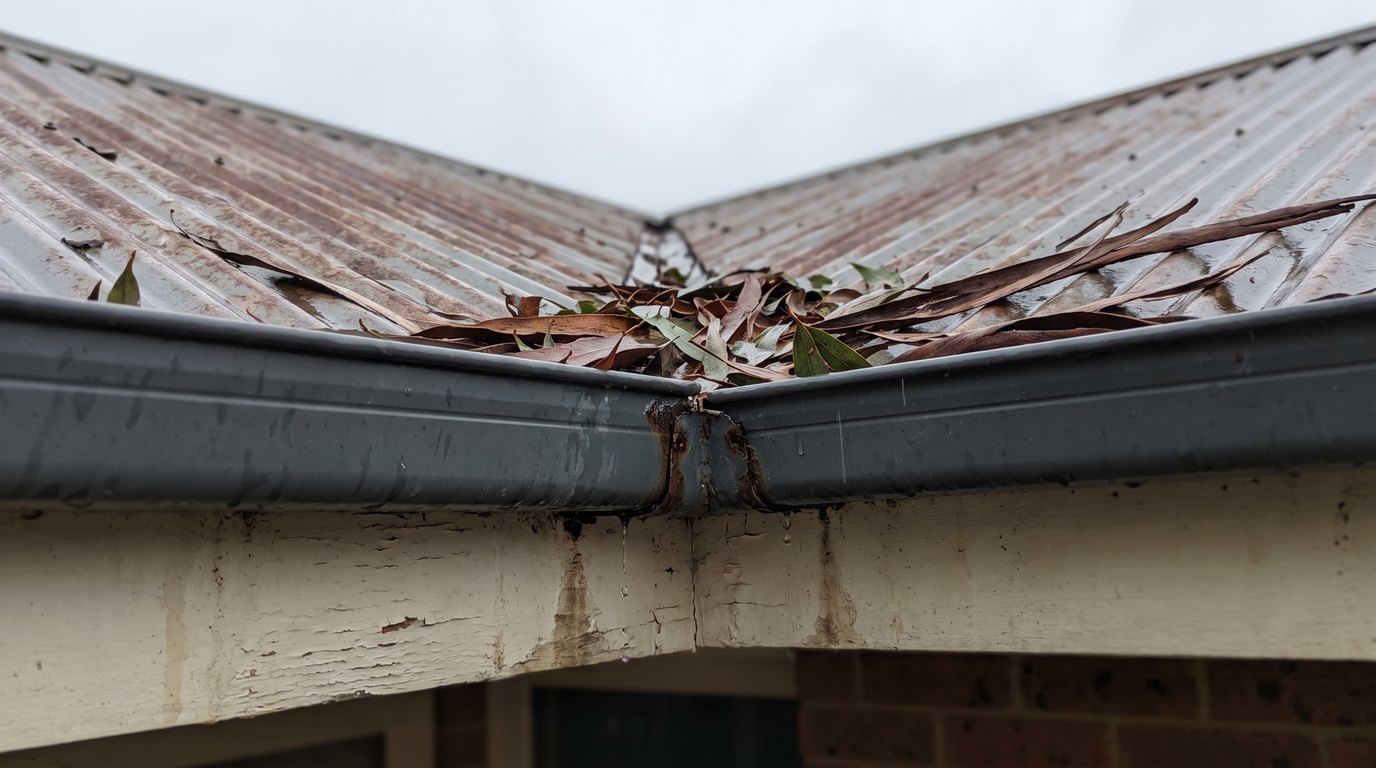
A gutter that drips is easy to put off. It is not flooding anything, it is just a stain on the fascia and a wet patch on the path, and there is always something more urgent.
The trouble is where that water lands. A slow leak puts moisture into the timber behind the gutter, the top of the wall and the ground hard against your footings, which is exactly where a house is least able to cope with it. Left through a Hobart winter, a small seal failure turns into a rotted fascia board or a damp internal wall.
The upside is that gutter leaks come from a short list of causes. Once you know which one you have, the fix is usually obvious. Here is how to work out what is actually leaking, what each repair involves, and where the line sits between a job you can sort yourself and one that legally needs a licensed plumber in Tasmania.
First, is it a leak or an overflow?
These two get confused constantly, and they need completely different fixes.
A leak is water escaping through the gutter itself, through a failed joint, a rust hole or a gap at an outlet. It drips in light rain, and it often keeps dripping for a while after the rain has stopped.
An overflow is water going over the edge because the gutter cannot carry what the roof is sending it. That usually points to a blockage, a fall running the wrong way, or simply a very heavy burst of rain.
Here is the part most guides skip: overflow in extreme rain is not automatically a fault. Australian eaves gutters are designed under AS/NZS 3500.3, the standard the National Construction Code points to for roof drainage, and the design case for an eaves gutter is a five minute burst of rain at a 5% annual exceedance probability. Rain heavier than that is expected to spill, which is why the standard also calls for overflow measures so the excess goes clear of the building instead of back into the eaves. Standards Australia has since published a revised edition, AS/NZS 3500.3:2025, which sets out clearer design rules for those overflow measures.
So a gutter that briefly runs over the front lip in a downpour may be doing its job. A gutter that drips in a light shower, or that sends water down the back of the fascia, is not. If yours is spilling regularly rather than leaking, our guide to blocked and overflowing gutters covers that side of it.
Why gutters leak
Almost every leak we see in Greater Hobart traces back to one of these.
- Failed joints and seams. Gutters expand and contract every time the temperature swings, and the sealant in a lap joint or a corner eventually hardens, shrinks and cracks. This is the single most common cause.
- Rust and pinholes. Debris holds water against the base of the gutter long after the rain has gone. On older galvanised steel that eventually eats through, and the first sign is usually a line of tiny drips rather than one obvious hole.
- The gutter outlet. The dropper that feeds the downpipe is a cut hole in the gutter floor, so it is a natural weak point. A leak here often looks like it is coming from the downpipe when the source is the joint above it.
- Loose brackets and lost fall. A sagging section holds standing water instead of moving it along. That accelerates corrosion and puts constant pressure on every joint in the sag.
- Water getting in behind the gutter. If the roof sheet or flashing does not extend far enough into the gutter, water tracks along the underside of the sheeting and runs down the back of the fascia. Nothing on the visible face of the gutter looks wrong at all.
- Blockages that never dry out. Compacted leaf litter and silt sit like a wet sponge, forcing water sideways into joints that would otherwise be fine.
Find the leak before you fix anything
Sealing the wrong spot is the most common wasted afternoon in gutter repair.
Pick a dry day and run a hose into the gutter from the far end, working towards the downpipe in sections. Watch from the ground while someone else feeds the water, because from up a ladder you cannot see where it is coming out underneath.
Mark every drip point with chalk or tape as you find it. Then check whether the leak shows up straight away or only once the gutter fills, which tells you whether you are dealing with a hole low in the gutter or a joint higher up the profile.
One more test worth doing: watch the gutter in genuinely heavy rain from under cover. A leak that only appears in a downpour, and appears behind the gutter rather than below it, usually means water is getting in over the back rather than out through the front.
How each type of leak gets fixed
Joints and seams. The proper fix is not to smear fresh sealant over the old. You separate the joint, scrape and wire brush out the perished sealant, clean the mating faces back to bare sound metal, let them dry completely, then re-bed and re-fasten with new sealant. Sealant applied over dirt, rust or old silicone will fail again within a season or two.
Holes and rust patches. A pinhole can be sealed. A patch of rust with holes through it cannot honestly be fixed with a patch, because the metal around the hole is already thin and the next hole is weeks away. Patching is a way to buy time until the section gets replaced, not a repair, and it is worth being clear with yourself about which one you are doing.
Outlets. Reseating a dropper properly means pulling it out of the downpipe and the gutter, cleaning both surfaces, and re-bedding it. Running a bead around the outside rarely holds, because the water pressure is on the inside face.
Brackets and fall. Replace corroded brackets rather than re-tightening them, and check the fall towards the downpipe with a string line while you are there. Fixing the fall often stops leaks you were about to seal, because the standing water causing them simply drains away.
Water behind the gutter. This one is not a sealant job. It usually needs the roof sheeting or the flashing adjusted so water is delivered into the gutter rather than over the back of it, which is roof plumbing rather than maintenance.
The sealant choice most guides skip
Not all silicone is safe on a metal gutter, and this catches plenty of people out.
Standard acetoxy or acetic cure silicone, the kind that smells strongly of vinegar as it sets, releases acetic acid while curing. On zinc coated and galvanised metal that acid can attack the very surface you are trying to protect, which is a poor idea inside a steel gutter.
Neutral cure silicone or a polyurethane gutter sealant is the appropriate choice for metal guttering. Manufacturers of both sealant types are consistent on this point, so it is worth turning the tube over and reading the label before you climb the ladder rather than after.
Whatever you use, the surface has to be clean, sound and bone dry. Sealant is only ever as good as what it is stuck to.
What makes Hobart gutters leak
Most gutter advice online is written for Sydney or Brisbane, where the assumption is a dry season and a storm season. Southern Tasmania does not work that way, and it changes the maintenance picture.
Hobart's rain is spread fairly evenly across the year rather than concentrated into a wet season. That means a gutter here rarely gets a long dry stretch to fully dry out, so debris stays damp, corrosion runs continuously, and a leak that starts in autumn does not politely wait for you.
Gum trees drop leaves, bark and small twigs all year rather than in one seasonal burst, and that fine bark is exactly the material that packs down into a wet mat in the base of a gutter. Shaded, south facing roofs in the foothills add moss and lichen to the mix, which holds moisture against the metal for even longer.
There is also a housing stock factor. Plenty of Hobart weatherboard homes still carry older galvanised guttering, or a mix of original galvanised and newer Colorbond where a section was replaced. Where two different metals meet, corrosion tends to concentrate at the join, so those transitions are always worth a close look when you are hunting a leak.
The Tasmanian licensing point worth knowing
This one genuinely matters if you are paying someone to do the work.
Roof plumbing in Tasmania has been restricted to licensed plumbers since 2010, when the occupational licensing laws changed. Consumer, Building and Occupational Services is the regulator, and its published guidance is clear that only a fully licensed roof plumber can advertise or perform roof plumbing work.
There is a limited exception. Since July 2018, licensed builders have been able to apply for a roof drainage endorsement that lets them carry out certain gutter, valley and flashing work. Read the scope closely, though, because that endorsement specifically excludes repairs to a roof plumbing installation when they are not associated with building work, and it excludes downpipe installation entirely.
In plain terms: a standalone gutter repair on an existing home is not covered by the builder endorsement. If someone is quoting you for guttering repairs, it is entirely reasonable to ask what licence they hold. A reputable operator will not mind the question.
We are a gutter cleaning and maintenance business, so we are upfront about that line ourselves. We clear, inspect and carry out minor gutter repairs across Greater Hobart, and where a leak needs a licensed roof plumber we will tell you that rather than sell you a fix that will not hold.
When a repair stops making sense
Sealing one tired joint is worthwhile. Sealing the fifth joint on the same run usually is not.
If a gutter has rust breaking through in more than one place, if the profile has deformed so it no longer holds a fall, or if the fascia behind it has gone soft, you are maintaining something that has reached the end of its life. Our guide to gutter repair versus replacement walks through where that line sits and what each option realistically costs you over the following few years.
Be honest about the ladder
Working at height on a Hobart roofline in winter is genuinely risky, and it is worth saying so plainly.
Safe Work Australia's figures show falls from a height caused 24 worker deaths in 2024, around 13% of all worker fatalities, and that roughly half of fatal falls involve heights of three metres or less. Those are workplace numbers rather than DIY ones, but a single storey gutter sits squarely in that range.
Add wet metal, a soft or sloping garden bed to stand a ladder on, and the sort of gusty southerly Hobart gets plenty of, and the odds shift further. Steep foothills blocks and two storey homes are firmly in call someone territory.
Get a leaking gutter looked at
Most leaks are cheap to fix and expensive to ignore, and the hardest part is usually working out which of the six causes above you actually have.
If you would rather have someone find it properly, get in touch with JK Gutter Cleaning Hobart for a no-obligation look over your gutters. We will tell you what is leaking, what it needs, and whether that is something we can sort or something for a licensed roof plumber.
Frequently asked questions
Can a leaking gutter be repaired, or does it need replacing?
Most leaks can be repaired. Failed joints, loose brackets, leaking outlets and isolated pinholes are all straightforward fixes. Replacement becomes the sensible call when rust has broken through in several places, the gutter has lost its fall, or the fascia behind it has been damaged.
What is the best way to seal a leaking gutter joint?
Separate the joint if you can, remove all the old sealant, clean the surfaces back to sound metal with a wire brush, and let them dry completely before applying a neutral cure silicone or polyurethane gutter sealant. Sealing over old sealant, rust or damp metal is the reason most DIY repairs fail within a year.
Why is water leaking behind my gutter rather than out of it?
That usually means water is getting in over the back of the gutter instead of escaping through it, often because roof sheeting or flashing does not extend far enough in. It is a roof plumbing issue rather than a sealant one, and no amount of sealing the front of the gutter will change it.
Is it normal for gutters to drip in heavy rain?
Brief spilling in an extreme downpour can be normal, because Australian eaves gutters are designed to a five minute rainfall intensity and are meant to have overflow measures for anything heavier. Dripping in light rain, or dripping after the rain has stopped, is not normal and points to a leak.
Do I need a licensed plumber for gutter repairs in Tasmania?
Roof plumbing work in Tasmania has been restricted to licensed plumbers since 2010, and the limited roof drainage endorsement available to builders excludes repairs that are not tied to building work. If you are engaging someone for guttering repairs, ask what licence they hold.
Need your gutters sorted in Hobart?
Book a fast, obligation-free quote with your local team.