
Signs Your Gutters Need Cleaning: A Hobart Guide
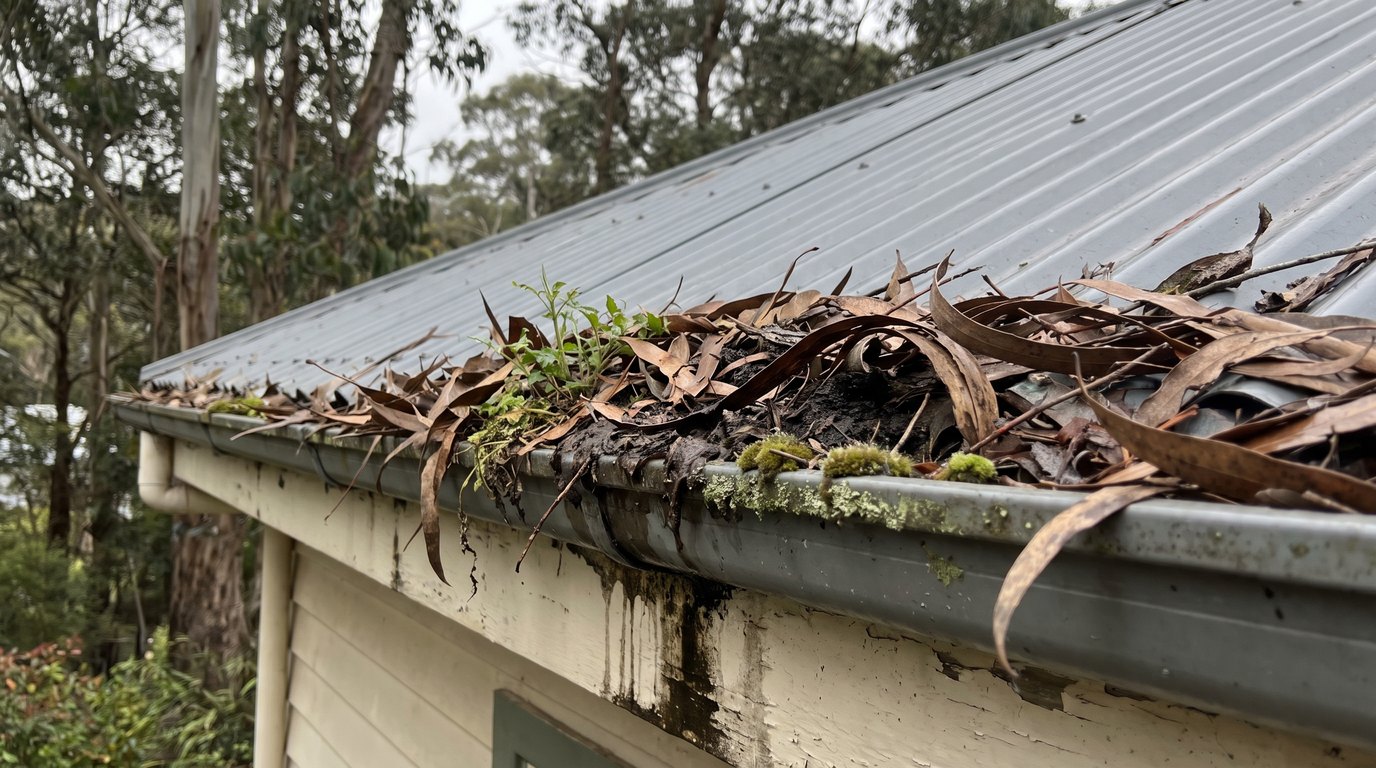
Most people find out their gutters are blocked the expensive way. A stain appears on a ceiling, or water starts sheeting down the outside of a wall every time it rains, and suddenly it is a roof problem rather than a maintenance job.
The frustrating part is that gutters give plenty of warning first. They just give it quietly, and nearly all of it is visible from your back lawn once you know what you are looking at.
Here is what to watch for around a Hobart home, what each sign tells you about the state of the gutter, and why the standard advice you will find online works less well here than it does on the mainland.
Why the usual "watch it in a downpour" test falls short here
Almost every article on this topic gives the same instruction: wait for heavy rain, walk around the house, and look for water spilling over the edge. It is sound advice in a city that gets its rain in big bursts. Hobart is not that city.
Bureau of Meteorology long-term averages for Hobart (Ellerslie Road) put annual rainfall at 611 mm spread across roughly 87 rain days a year, and the spread across the calendar is remarkably flat. The driest month averages 38.8 mm and the wettest averages 62.0 mm. We get frequent light rain rather than the intense downpours that force a blocked gutter to declare itself.
That matters more than it sounds. A gutter can be three-quarters full of compacted leaf mulch and still handle a typical Hobart shower without a drop going over the edge. You never see the overflow, so nothing prompts you to act, and the blockage keeps building until a heavy spring burst or a storm finally overwhelms it.
So in Hobart, overflow is worth checking, but treat it as the last sign to appear rather than the first. The quieter ones below will reach you earlier.
The signs you can spot from the ground
None of these need a ladder. A slow walk around the house, ideally once during rain and once on a dry day, will find most of them.
Water spilling over the edge during rain
The obvious one, and still the most definitive. If water runs over the lip of the gutter instead of tracking along to a downpipe, the channel is blocked and damage is happening every time it rains. Given how rarely Hobart rain is heavy enough to produce this, seeing it at all means the blockage is well advanced. More on the mechanics in our guide to blocked and overflowing gutters.
Plants, moss or lichen growing along the gutter line
Weeds and grass sprouting from a gutter mean there is enough decomposed organic matter sitting in there to act as soil, which takes months to build up. In Hobart there is a milder version worth knowing about: moss and lichen colonising the gutter and the shaded side of the roof. Our cool, damp conditions and the number of south-facing and tree-shaded rooflines around the foothills make this common, and it is an early sign that debris is holding moisture rather than draining.
The gutter is sagging or pulling away from the fascia
Gutters are sized to carry water, not kilograms of saturated leaf litter. When a run visibly dips in the middle or the top edge starts to lean away from the fascia board, the brackets are being overloaded. Sagging is self-worsening, because the low point then holds standing water after every shower, which accelerates corrosion.
Staining or paint failure on the fascia and walls
Dark streaks, watermarks or bubbling paint on the timber fascia directly under a gutter mean water has been overflowing or sitting against it repeatedly. On the older weatherboard housing stock around Hobart this is worth catching early, because timber fascia that stays wet through a cool winter softens and then rots from the surface inwards.
Downpipes that gurgle, or go silent
Stand near a downpipe during rain. A clear pipe sounds like water rushing through it. A partly blocked one gurgles and bubbles. A fully blocked one is oddly silent while the gutter above it fills up. Blockages usually compact at the first bend, which is why flushing with a hose often makes it worse rather than better. We cover the fix in downpipe cleaning and unblocking.
Birds and possums working the roofline
Birds walking the length of a gutter rather than perching on it are usually collecting nesting material, which means there is loose debris up there to collect. Possums use gutter litter the same way. A nest is far worse than loose leaves, because it forms a dense plug that water cannot get past at all.
Visible debris above the gutter line
Simple, and often overlooked. If you can see leaf tips, twigs or bark poking above the front lip of the gutter from ground level, the gutter is already full to the brim. Anything visible from below is the top of a much deeper pile.
The signs that mean it has gone past maintenance
These are the ones where the gutter is no longer the only problem.
- Water marks or damp patches on interior ceilings and upper walls, particularly near the roofline. Water backing up in a blocked gutter can track under the roof edge and into the cavity.
- Rust patches, pinholes or standing water inside the gutter. Wet debris holds moisture against the metal continuously, and once corrosion is through, cleaning alone will not stop the leak.
- Water pooling against the house after rain, or soil eroding away from the base of a wall. That is roof water being dumped in one spot instead of being carried to stormwater.
If you are seeing any of these, the question shifts from cleaning to whether something needs repairing as well. Our guide on gutter repair versus replacement covers where that line usually sits.
In Tasmania, it is bark as much as leaves
Most gutter advice online is written around deciduous leaf fall, which is a tidy, seasonal, once-a-year event. That is only half the story here.
Eucalypts drop leaves, twigs, nuts and long ribbons of shed bark year round, and the bark is the problem. Ribbons drape across the gutter and knit the loose debris into a mat that water cannot filter through, and they are far more likely than leaves to wedge in the top of a downpipe. If you have gums over or near your roofline, gutters can go from clear to genuinely blocked outside autumn entirely, which catches out anyone working to a mainland cleaning calendar.
The practical upshot is that around here, the sign to act on is what you can see in the gutter, not what month it is.
The sign that only matters in summer
Dry leaf litter sitting in a gutter is a bushfire risk, and it is one the Tasmania Fire Service is direct about. Its Bushfire Safety Guide notes that most houses that catch fire during bushfires do so because of embers, which are burning twigs, leaves and debris blown ahead of the fire by wind, and that embers landing on a property can start fires in gutters and under eaves. TFS lists cleaning gutters among the simple things to do regularly during bushfire season, and clearing leaves from roof gutters among the things to do before the season starts.
Embers can also keep falling for hours after a fire front has passed, which is why a gutter full of dry fuel is a risk well beyond the moment of the fire itself. If your place backs onto bushland, treat visible dry debris in the gutter in November as urgent regardless of whether it is causing any drainage problem at all. There is more in our piece on getting your gutters ready for bushfire season.
When the honest answer is "I can't remember"
If you cannot recall the last clean, or you know it has been more than a year, that is reason enough on its own. You do not need a visible symptom.
A year of eucalypt litter is comfortably enough to fill a standard quad gutter in most Hobart suburbs, and a good deal less than a year if you have gums directly overhead. What the right interval looks like depends heavily on your trees, your roof pitch and how sheltered the site is, which we go through in our guide to how often you should clean your gutters.
Checking safely, and where to stop
Everything above can be assessed from ground level, and that is deliberate. There is no version of this where climbing up for a look is the sensible first move.
Falls from a height were the second largest cause of work-related deaths in Australia in 2024, accounting for 24 fatalities or 13 per cent of the total, according to Safe Work Australia. That is workplace data rather than household data, but it is a fair indication of how unforgiving the job is even for people who do it daily with proper equipment. A wet Colorbond roof on a steep Hobart block in winter is genuinely dangerous, and a great many homes here sit on exactly that kind of site.
If you want to see inside the gutter without going up, a phone camera taped to a broom handle and held over the edge works well and keeps both feet on the ground.
Once you have confirmed there is a problem, the clean itself is the part worth handing over. We work off a high-reach gutter vacuum system rather than scooping by hand, which keeps our team off the roof on most jobs, lifts compacted wet silt and bark that a scoop or hose will not shift, and puts the debris into the machine rather than over your garden.
Get a straight answer about your gutters
If you have ticked off one or two of the signs above and you are not sure how urgent it is, the quickest way to know is to have someone look properly.
Get in touch with JK Gutter Cleaning Hobart for a no-obligation quote across Greater Hobart and southern Tasmania. We will tell you what we find, including if the honest answer is that they can wait.
Frequently asked questions
How can I tell if my gutters need cleaning without climbing a ladder?
Nearly every reliable sign is visible from ground level. Look for water spilling over the edge during rain, plants or moss along the gutter line, sagging runs or gutters leaning away from the fascia, staining on the fascia board, and debris poking above the front lip. Listening to a downpipe during rain will tell you whether it is flowing, gurgling or blocked.
Why don't my gutters overflow even though they look full?
Hobart's rainfall is spread evenly through the year and rarely intense, so a badly blocked gutter can still cope with an average shower without spilling. Bureau of Meteorology averages for Hobart put annual rainfall at 611 mm across about 87 rain days. That means overflow tends to be a late signal here, and visible debris is a more reliable early one.
Does gutter guard mean I can stop watching for these signs?
No. Quality guard cuts down how often gutters need clearing, but fine debris, bark fragments and windblown grit still settle on top of and beneath the mesh. Guarded gutters need less frequent attention, not none, so the same ground-level checks are still worth doing.
Should I get gutters cleaned before summer or after autumn?
Both have a purpose. A clean before summer removes dry leaf litter ahead of bushfire season, which the Tasmania Fire Service recommends as part of preparing a property. A clean after the main autumn leaf fall clears the bulk of the year's debris ahead of winter rain. Homes under eucalypts often need attention outside both windows, because gums shed bark and leaves year round.
Need your gutters sorted in Hobart?
Book a fast, obligation-free quote with your local team.